

Dubai’s New Legal Shield for Real Estate, Institutional Asset Baskets Replace Risky Individual Property Tokens
Real World Assets
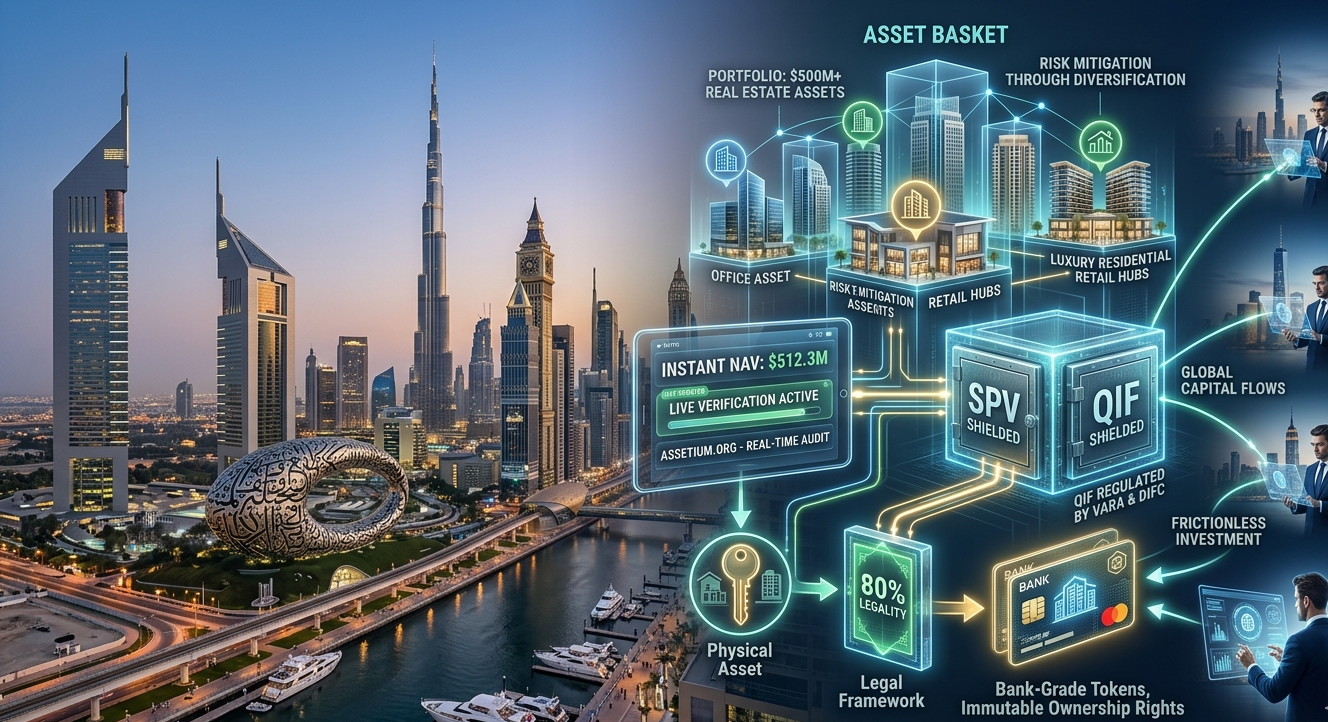
Integrating QIF and SPV structures, a new 80% legal and 20% tech model enables instant NAV and live verification for global investors in times of conflict.
Tokenization is 80% legal. With QIF funds and live verification, Dubai enables investing in asset baskets with instant NAV without traveling," states Mauricio Correa, executive at Assetium”
DUBAI, DUBAI, UNITED ARAB EMIRATES, April 11, 2026 /EINPresswire.com/ -- The global real estate market is undergoing its most significant structural transformation in decades. As geopolitical instability in 2026 and increasing logistical barriers for physical auditing weigh on traditional markets, institutional investors including banking institutions, hedge funds, and family offices are pivoting away from direct acquisition models. In their place, high-complexity digital financial architectures are emerging as the new standard. Dubai, under the strategic umbrella of its D33 Economic Agenda and the regulatory oversight of VARA, has consolidated its position as the global hub for a model where legal certainty finally takes precedence over technical novelty.— Jonathan Hale
The 80/20 Rule: Legal Architecture as the Primary Infrastructure
Market analysts increasingly agree that the success of institutional tokenization lies not in the underlying blockchain code, but in the rules of the game. Modern tokenization is now defined as 20% technology and 80% legality. The primary driver of the massive capital traction seen in the United Arab Emirates is the strategic utilization of Special Purpose Vehicles (SPV) and Qualitative Investor Funds (QIF).
These legal instruments ensure that assets are not merely recorded on a ledger, but shielded under international property laws. This framework provides bank-grade financial instruments with immutable ownership rights, protecting global capital from administrative paralysis or the jurisdictional risks often associated with cross-border real estate in times of war.
The Rise of Asset Baskets and the End of Single-Asset Risk
A disruptive trend is gaining momentum among large-scale corporations: the move away from single-asset concentration. The market is rapidly migrating toward an Asset Basket model. Instead of tokenizing an individual property which carries localized operational risk corporations are now integrating vast portfolios valued in the hundreds of millions of dollars under a single digital command.
This One Token to Rule Them All approach offers critical institutional advantages:
* Systemic Risk Mitigation: Investor returns are tied to a diversified portfolio’s resilience rather than a single physical unit.
* Instant NAV Liquidity: Unlike traditional real estate funds that offer quarterly valuations, new institutional models utilize Instant NAV (Net Asset Value) updates. This allows fund managers to monitor, rebalance, and adjust positions in real-time, providing a level of liquidity previously unheard of in the property sector.
* Live Verification Protocols: The dependency on physical travel for due diligence is being replaced by Live Verification. This involves constant, autonomous auditing of the physical and legal status of the assets.
Establishing the Trust Bridge
For this institutional model to function, the existence of dynamic auditing infrastructures is vital. Specialized systems, such as those provided by Assetium (assetium.org), are leading this category. By functioning as a real-time verification node, such platforms act as a trust bridge between the physical world and the global investor. These technologies ensure that even if borders are closed or travel is restricted, the underlying asset remains observable, governable, and verifiable 24/7.
A Future of Frictionless Global Investment
The combination of QIF funds, robust SPV shielding, and live verification is creating a real estate market that operates with the agility of the foreign exchange market. By eliminating the dependency on physical presence, institutional tokenization is allowing global capital to find its way toward high-stability jurisdictions like Dubai, ensuring wealth preservation in an increasingly uncertain world.
About the Evolution of Real World Assets (RWA) in Dubai
Dubai’s financial ecosystem leads the global convergence between traditional commercial law and distributed ledger technology. Through the collaboration between regulators and infrastructure platforms like Assetium, the Emirate offers the world’s most solid structure for the custody, management, and settlement of large-scale real estate assets.
Jonathan Hale
Veltrika
email us here
Visit us on social media:
LinkedIn
Legal Disclaimer:
EIN Presswire provides this news content "as is" without warranty of any kind. We do not accept any responsibility or liability for the accuracy, content, images, videos, licenses, completeness, legality, or reliability of the information contained in this article. If you have any complaints or copyright issues related to this article, kindly contact the author above.
